Christian Life in First-Century Ephesus
By Meridith Curtis
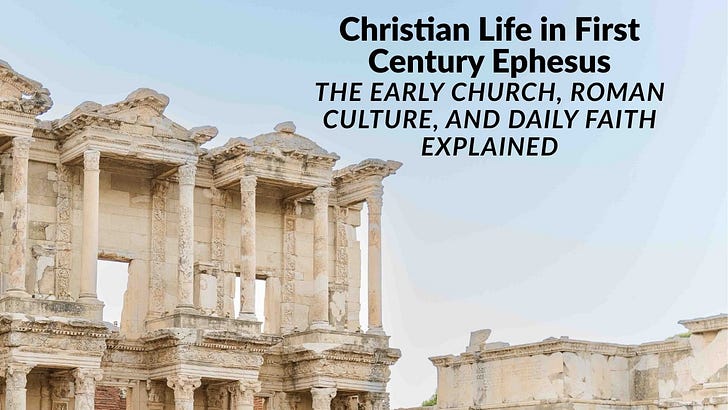
The letter to the Ephesians is often read as a deeply theological text—and it is.
But it was not written in a vacuum.
It was written to a real church in a real city, shaped by real pressures: Ephesus, one of the most influential urban centers in the Roman Empire.
When we understand that context, the theology of Ephesians becomes even more striking. Paul wasn't writing abstract doctrine. He was speaking directly into the formation of an emerging church learning how to live faithfully in a culture saturated with competing loyalties.
This video explores that world—and helps us see how Paul's theology was aimed at shaping a people, not just informing their beliefs.
A Church Formed in a Complex City
Ephesus was a city defined by layers of influence:
- Roman political authority
- economic systems tied to trade and guilds
- the Imperial Cult and loyalty to Caesar
- and deeply embedded Artemis worship
This wasn't a spiritually neutral environment. It was a city where identity was formed through participation in public life, religious devotion, and civic allegiance.
Into that environment, the gospel took root.
And a church began to form.
Ephesians as Formation, Not Just Instruction
Paul's letter to the Ephesians is not simply a theological summary—it is a vision for a new kind of people.
In a world where identity was shaped by empire, economy, and pagan religion, Paul declares a radically different reality:
- Christ is seated above every power and authority
- The church is the body of Christ in the world
- Salvation is by grace, not civic or religious performance
- A new humanity is being formed in Christ
These were not abstract ideas. They were identity-shaping truths for believers navigating daily life in Ephesus.
Theology Written Into Cultural Pressure
When Paul writes to the Ephesians, he is addressing a church learning how to live inside tension.
They were:
- navigating economic systems tied to idol worship
- living in a city devoted to Artemis and Caesar
- learning to form households, communities, and identities around Jesus
- and discovering what it meant to belong to a kingdom not defined by Rome
The theology of Ephesians speaks directly into that pressure.
It reframes reality: not just what Christians believe, but how they understand the world they live in.
A New Identity in the Midst of Old Systems
One of Paul's central themes is identity.
In Ephesus, identity came from:
- civic belonging
- religious participation
- economic status
- and imperial loyalty
But Paul insists that in Christ, believers receive a new identity that transcends all of these systems.
They are:
- chosen in Christ
- adopted into God's family
- seated with Christ in heavenly places
- and formed into one new humanity
This was not theoretical theology. It was survival-level formation for a church living inside competing allegiances.
Unlocking the Riches of Ephesians
If you want to go deeper into this letter, I've written Unlocking the Riches of Ephesians, an inductive Bible study on Paul's letter to the Ephesians. This study is designed to help you slow down, observe the text carefully, and uncover the depth of Paul's theological vision for the church. Rather than simply reading Ephesians for information, it guides you to engage it as formation—seeing how every passage shapes identity, community, and life in Christ within a real-world cultural context like Ephesus.
Why Ephesians Still Speaks Today
While we are far removed from first-century Ephesus, the core tension remains familiar.
Every culture forms identity through systems of belonging, loyalty, and meaning.
The letter to the Ephesians continues to speak because it re-centers those identities around Christ and His kingdom.
It calls believers then—and now—to live as a people formed by a different reality.
Watch the Teaching
This video explores Christian life in first-century Ephesus and how Paul's letter to the Ephesians directly shaped a church living under cultural, religious, and political pressure.
🎥 Watch here: Christian Life in First Century Ephesus: The Early Church, Roman Culture, and Daily Faith Explained
<iframe width="100%" height="400" src="https://www.youtube.com/embed/UIvh-l7KeCc" frameborder="0" allowfullscreen></iframe>Resources & Ways to Connect
📖 Buy Mer's books: https://books.by/meridith-curtis
If this helps you see Ephesians in a new light, consider sharing it or exploring the full Ephesus Expedition series.
Want to study the biblical world firsthand and be trained for mission? MTC Nashville offers disciple-making training and a residency program in Nashville. Learn more at https://mtc-nashville.com.
Back to Field Notes