Mary, John, and Ephesus
By Meridith Curtis
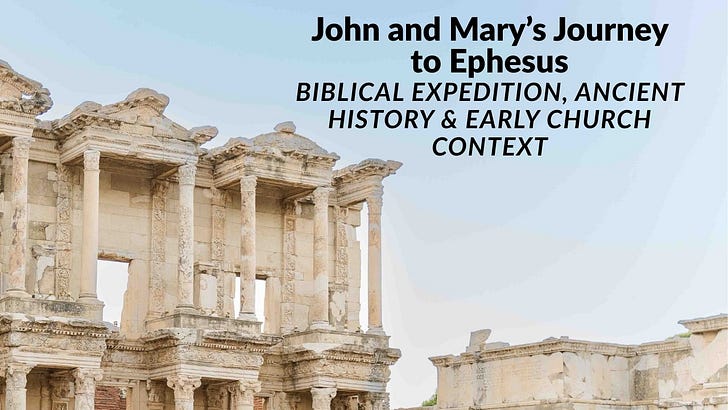
Ephesus is one of the most well-documented cities in the New Testament world—but it also sits at the intersection of Scripture, church history, and long-standing tradition.
When we talk about John and Mary's connection to Ephesus, we are not dealing with a single verse that answers every question neatly. Instead, we are tracing a biblical foundation, early church testimony, and historical tradition that together form a compelling picture of why Ephesus became so significant in the story of the early church.
In this video, we explore that intersection carefully—looking at what the Bible clearly says, what early Christian history records, and what is known about the traditional site often referred to as "Mary's House" in Ephesus.
What the Bible Actually Says
The New Testament gives us several key anchors for understanding John's connection to Ephesus.
Most notably, church tradition and early historical writings strongly associate the Apostle John with Ephesus in his later ministry. While the Bible does not explicitly narrate every detail of John's relocation, it does affirm his continued leadership role in the early church and his enduring presence among the communities of Asia Minor.
The Book of Revelation, addressed to the seven churches of Asia—including Ephesus—also reflects John's deep connection to this region (Revelation 1–3).
So while Scripture does not give a full biography of John's final years, it clearly places him within the orbit of the churches of Asia Minor, with Ephesus as a central hub.
What Church History Records
Early church writers such as Irenaeus, Eusebius, and others preserve a strong tradition that the Apostle John lived in Ephesus during the later part of his life and ministry.
According to these accounts:
- John ministered in Ephesus after the Apostle Paul's earlier work there
- He continued to disciple and oversee churches in the surrounding region
- He remained there until the reign of Emperor Trajan in the early 2nd century
While these are not biblical texts, they are among the earliest available testimonies from the post-apostolic church and were widely accepted in early Christian communities.
Together, they form a consistent historical tradition connecting John to Ephesus in a unique and lasting way.
What About Mary?
Mary, the mother of Jesus, is not explicitly said in Scripture to have lived in Ephesus.
However, there is an important biblical detail that has shaped centuries of reflection:
In John 19:26–27, Jesus entrusts His mother Mary to the care of the beloved disciple (traditionally identified as John), saying:
"Woman, behold your son… Behold, your mother."
From that moment, the text tells us that the disciple took her into his home.
Because of this passage, early Christian tradition developed the belief that Mary lived under John's care after the resurrection and ascension of Jesus. Since John is strongly associated with Ephesus in early church history, it is from this convergence that the tradition of Mary living in or near Ephesus emerged.
It is important to say clearly:
- The Bible does not explicitly state Mary traveled to Ephesus
- This connection comes from early church tradition and later historical reflection
- It is held by many Christian traditions, but not established as direct biblical narrative
"Mary's House" in Ephesus
On the slopes near ancient Ephesus, there is a site traditionally identified as "Mary's House" (Meryem Ana Evi).
This site became widely known in modern times after reported visions in the 19th century described Mary living in this region under John's care. Archaeological interest and later pilgrimages led to the identification of a small stone structure believed by some to be her final residence.
Today, it is a recognized pilgrimage site visited by both Christians and Muslims, though its identification is based on tradition rather than direct archaeological proof.
What we can say responsibly is:
- It is a site of longstanding Christian tradition
- It reflects centuries of belief connecting Mary, John, and Ephesus
- It cannot be definitively verified as Mary's historical home
Why This Matters for Reading Scripture
Whether or not every detail of tradition can be historically verified, what is clear is this:
Ephesus became one of the most important centers of early Christianity.
It was a place where:
- Paul ministered extensively
- the gospel took deep root in a major Roman city
- John is strongly associated through early church tradition
- and the early church flourished in a complex cultural environment
When we step back, we see a consistent thread: Ephesus matters.
Not just historically, but in how we understand the spread of the gospel and the formation of the early church.
Unlocking the Riches of Ephesians
If you want to go deeper into this letter, I've written Unlocking the Riches of Ephesians, an inductive Bible study on Paul's letter to the Ephesians. This study is designed to help you slow down, observe the text carefully, and uncover the depth of Paul's theological vision for the church. Rather than simply reading Ephesians for information, it guides you to engage it as formation—seeing how every passage shapes identity, community, and life in Christ within a real-world cultural context like Ephesus.
Watch the Video
🎥 John and Mary's Journey to Ephesus: Biblical Expedition, Ancient History & Early Church Context
<iframe width="100%" height="400" src="https://www.youtube.com/embed/EH7OP6pjfLo" frameborder="0" allowfullscreen></iframe>Resources & Ways to Connect
📖 Buy Mer's books: https://books.by/meridith-curtis
Want to study the biblical world firsthand and be trained for mission? MTC Nashville offers disciple-making training and a residency program in Nashville. Learn more at https://mtc-nashville.com.
Back to Field Notes