Origins and Evolution of Artemis
By Meridith Curtis
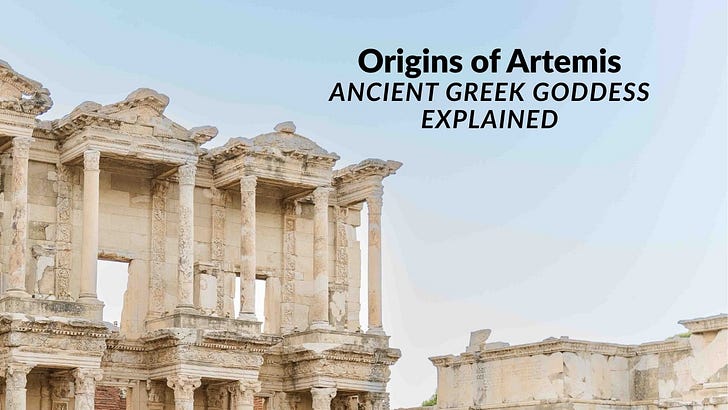
When we read about Artemis in the New Testament, it's easy to assume we're dealing with a single, fixed idea of a goddess.
But ancient religion doesn't work that way.
Deities evolved over time—absorbing local traditions, political identity, cultural symbolism, and regional adaptations. Artemis is a perfect example of this process.
And in Ephesus, she became something far more than a mythological figure.
She became the identity of a city.
From Greek Artemis to Roman Diana
In Greek tradition, Artemis was known as the goddess of the hunt, wilderness, and childbirth—often portrayed as a protector and a figure associated with nature and independence.
As the Roman Empire expanded, Artemis became identified with Diana, a parallel deity within Roman religious structure.
But the story doesn't stop there.
Because in Ephesus, Artemis took on a unique form that was distinct from her Greek and Roman counterparts.
She became localized.
Adapted.
Reimagined.
The Ephesian Artemis: A Unique Expression
The Artemis worshiped in Ephesus was not identical to the Greek version found elsewhere.
Instead, she developed into a distinctly Ephesian form—often associated with fertility, abundance, and civic identity. Her imagery, symbolism, and rituals reflected the needs and worldview of the city itself.
This transformation tells us something important:
Ancient gods were not static ideas—they were living cultural systems.
And Ephesus shaped Artemis just as Artemis shaped Ephesus.
Why Ephesus Became Her Center
Over time, Ephesus became the most significant center of Artemis worship in the ancient world.
The city's massive Temple of Artemis—one of the Seven Wonders of the Ancient World—stood as both a religious and economic anchor.
But more than that, Artemis became tied to:
- civic pride
- economic stability
- cultural identity
- and political legitimacy
To be Ephesian was to be connected to Artemis.
She was not just worshiped in the city—she defined the city.
Why This Matters for Understanding the New Testament
When we step into the world of Acts, Paul's ministry in Ephesus suddenly takes on deeper meaning.
The conflict described in Scripture was not just about ideas or competing religions.
It was about an entire system of identity.
Turning to Jesus wasn't simply adopting a new belief.
It meant reorienting loyalty away from the gods tied to:
- the economy
- the city's pride
- and the structure of public life
That's why the message of the gospel created such tension in Ephesus. It didn't just challenge private spirituality—it challenged a deeply embedded cultural framework.
Seeing the World Behind the Text
One of the most powerful ways to grow in understanding Scripture is to slow down and ask what the world behind the text actually looked like.
Because when we do, passages we've read many times begin to expand in meaning.
Artemis is not just background mythology.
She is part of the world the early church had to faithfully navigate, and ultimately, a world transformed by the message of Jesus.
Unlocking the Riches of Ephesians
If you want to go deeper into this letter, I've written Unlocking the Riches of Ephesians, an inductive Bible study on Paul's letter to the Ephesians. This study is designed to help you slow down, observe the text carefully, and uncover the depth of Paul's theological vision for the church. Rather than simply reading Ephesians for information, it guides you to engage it as formation—seeing how every passage shapes identity, community, and life in Christ within a real-world cultural context like Ephesus.
Watch the Teaching
This video traces the origins and evolution of Artemis and explains how her identity developed across Greek, Roman, and Ephesian contexts.
🎥 Watch here: Origins and Evolution of Artemis: From Ancient Greek Goddess to Roman Diana Explained
<iframe width="100%" height="400" src="https://www.youtube.com/embed/zOhE4p-uu7s" frameborder="0" allowfullscreen></iframe>Resources & Ways to Connect
📖 Buy Mer's books: https://books.by/meridith-curtis
Our hope is that these studies help you see Scripture more clearly, understand the world of the early church more deeply, and follow Jesus with greater confidence in every context He places you in.
Want to study the biblical world firsthand and be trained for mission? MTC Nashville offers disciple-making training and a residency program in Nashville. Learn more at https://mtc-nashville.com.
Back to Field Notes