Paul in Ephesus
By Meridith Curtis
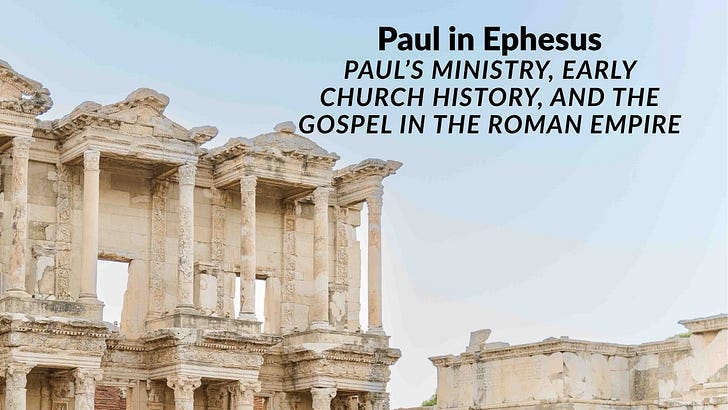
Few chapters in the book of Acts capture the intensity, power, and cultural collision of the early church like Acts 19.
Here we see the Apostle Paul in Ephesus—not as a distant theological voice, but as a missionary confronting a deeply entrenched spiritual system, proclaiming the risen Christ in the heart of a major Roman city.
Ephesus becomes more than a location in Acts.
It becomes a theological battlefield where the kingdom of God is revealed as both present and advancing.
Paul Arrives in Ephesus: The Gospel Enters a Strategic City
Paul's arrival in Ephesus is part of his broader missionary strategy, shaped by the Spirit's leading and the expansion of the gospel across Asia Minor.
Acts 19 opens with Paul finding disciples who had only known the baptism of John. He immediately begins to teach them about Jesus:
"Paul said, 'John baptized with the baptism of repentance, telling the people to believe in the one coming after him, that is, Jesus.'" (Acts 19:4)
From the beginning, we see Paul's central mission in Ephesus: to fully reveal Christ and establish a Spirit-empowered church rooted in the finished work of Jesus.
After laying this foundation, Luke records a key moment:
"The Holy Spirit came on them, and they began speaking in tongues and prophesying." (Acts 19:6)
This marks a theological theme running throughout Acts—Jesus is not only preached, but actively present by His Spirit among His people.
Teaching Daily in the Hall of Tyrannus: A New Center of Formation
Acts 19:9–10 describes a major shift in Paul's ministry:
"He withdrew from them and took the disciples with him, reasoning daily in the hall of Tyrannus. This continued for two years, so that all the residents of Asia heard the word of the Lord."
This is not a side detail. It is a theological statement about how the gospel spreads.
Ephesus becomes a hub of formation, where daily teaching produces a multiplying movement that reaches "all the residents of Asia."
The kingdom does not advance primarily through political power or cultural dominance, but through sustained discipleship and Spirit-empowered teaching.
Spiritual Power Confronted: The Sons of Sceva and the Name of Jesus
One of the most striking sections of Acts 19 is the confrontation with spiritual authority:
"Jesus I know, and Paul I recognize, but who are you?" (Acts 19:15)
This moment reveals a critical theological truth: the authority of Jesus is not symbolic—it is real, active, and recognized in the unseen realm.
The result is described in Acts 19:17:
"And fear fell upon them all, and the name of the Lord Jesus was extolled."
The gospel does not merely add another religious option to Ephesus. It exposes counterfeit power and establishes the supremacy of Christ over all spiritual forces.
Economic Disruption: The Gospel and the Temple of Artemis
Perhaps the most dramatic moment comes when the gospel begins to affect the economy of the city.
Demetrius, a silversmith who made shrines of Artemis, gathers other craftsmen and warns:
"This business of ours is in danger… and the temple of the great goddess Artemis may be counted as nothing." (Acts 19:25–27)
What follows is a city-wide uproar.
This is not simply religious disagreement. It is economic and cultural disruption.
The gospel is so effective in transforming lives that entire industries tied to idol worship begin to feel threatened.
The cry of the crowd becomes:
"Great is Artemis of the Ephesians!" (Acts 19:28)
Here we see a direct collision between the kingdom of God and the systems of idolatry that defined Ephesian identity.
Theological Significance: The Kingdom in the Midst of Empire
Acts 19 is not just a historical record—it is a theological revelation.
It shows us:
- The authority of Jesus over spiritual powers
- The presence of the Holy Spirit in forming the church
- The power of discipleship to transform regions
- And the inevitable conflict between the gospel and idol-centered systems
Ephesus becomes a living example of what happens when the reign of Christ enters a deeply structured cultural world.
The gospel does not remain private.
It reshapes everything it touches.
Unlocking the Riches of Ephesians: Seeing Paul's Theology Formed in Ephesus
If Acts 19 shows us the formation of the Ephesian church, then the letter to the Ephesians shows us its theological depth.
That's why I wrote Unlocking the Riches of Ephesians, an inductive Bible study designed to help readers engage Paul's letter in its full richness and context.
This study invites you to slow down and observe the text carefully, tracing Paul's theology as it emerges from the very environment we see in Acts 19. You begin to see how themes like spiritual authority, unity in Christ, new identity, and life in the Spirit are not abstract doctrines—but truths forged in the reality of a city like Ephesus.
Ephesians becomes more than a letter.
It becomes a vision for a people formed in the middle of cultural pressure, spiritual conflict, and gospel expansion.
Conclusion: A Church Born in Conflict, Sustained by Christ
Paul's ministry in Ephesus reveals something essential about the early church: it was not built in comfort, but in confrontation.
And yet, through that confrontation, the church did not retreat.
It multiplied.
Acts 19 ends with the word of the Lord continuing to prevail mightily (Acts 19:20). That phrase captures the theological heartbeat of the chapter: the kingdom of God advances not by force, but by the unstoppable presence of Christ through His Spirit and His people.
Watch the Teaching
🎥 Paul at Ephesus: Acts 19, Early Church History, and the Gospel in a Roman City
<iframe width="100%" height="400" src="https://www.youtube.com/embed/z-SHIoSTAOg" frameborder="0" allowfullscreen></iframe>Resources & Ways to Connect
📖 Unlocking the Riches of Ephesians – Inductive Bible Study on Paul's Letter https://books.by/meridith-curtis
Want to study the biblical world firsthand and be trained for mission? MTC Nashville offers disciple-making training and a residency program in Nashville. Learn more at https://mtc-nashville.com.
Back to Field Notes